Top Five Hotels Around the World With Remarkable Art Collections
 Read later
 Share
Share
Art has long occupied a distinct place in the language of wealth, where a painting in a serious private collection speaks to taste, patience and access to a new world. The right work by the right artist carries a cultural value that no balance sheet can capture, which is part of why such collections matter so much to those who assemble them.
Hospitality has traditionally treated art rather differently, using it to complement an interior rather than define it, but that distinction is beginning to fade. A handful of hotels around the world have woven genuine art collections into their identity, placing significant works throughout their public spaces, guest rooms and grounds, so that the art becomes as much a part of the property as the architecture itself.
This changes how guests actually encounter the work. Rather than moving through a gallery before closing time, they live alongside it over the course of a stay, returning to the same paintings again and again until they become part of the rhythm of the visit rather than a single, fleeting impression.
For travellers with a serious interest in art, this offers something no conventional luxury hotel can replicate: proximity without ownership. These five hotels have made that closeness part of the experience itself.
The Dolder Grand, Zurich
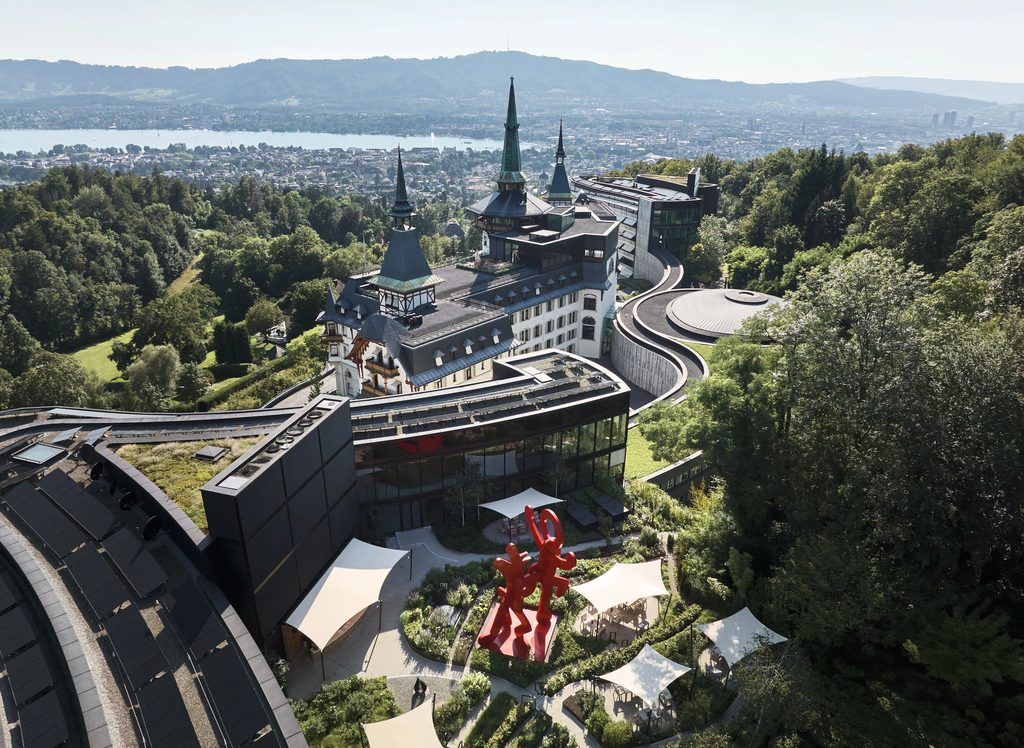
Placed above Zurich with views across the lake and the Alps, The Dolder Grand has made art one of its defining features. Its collection comprises more than 100 works by around 90 artists, displayed throughout the hotel, with many placed in public areas rather than confined to a dedicated gallery. Each artwork comes with a QR code that lets guests learn more about the artist and the piece as they move through the property.
The collection was assembled by hotel owner and collector Urs Schwarzenbach, who acquired works over several decades and placed many of them throughout the hotel after its reopening in 2008. Among its most prominent works is Andy Warhol’s Big Retrospective Painting, an 11-metre-long canvas overlooking the lobby, and Salvador Dalí’s Femmes métamorphosées – Les sept arts is another major work in the collection.
The effect is unusual for a hotel of this scale. Works by artists including Warhol, Dalí, Keith Haring and Takashi Murakami form part of the route through the property, so guests encounter the collection as part of the stay rather than visiting it separately.
The Fife Arms, Braemar
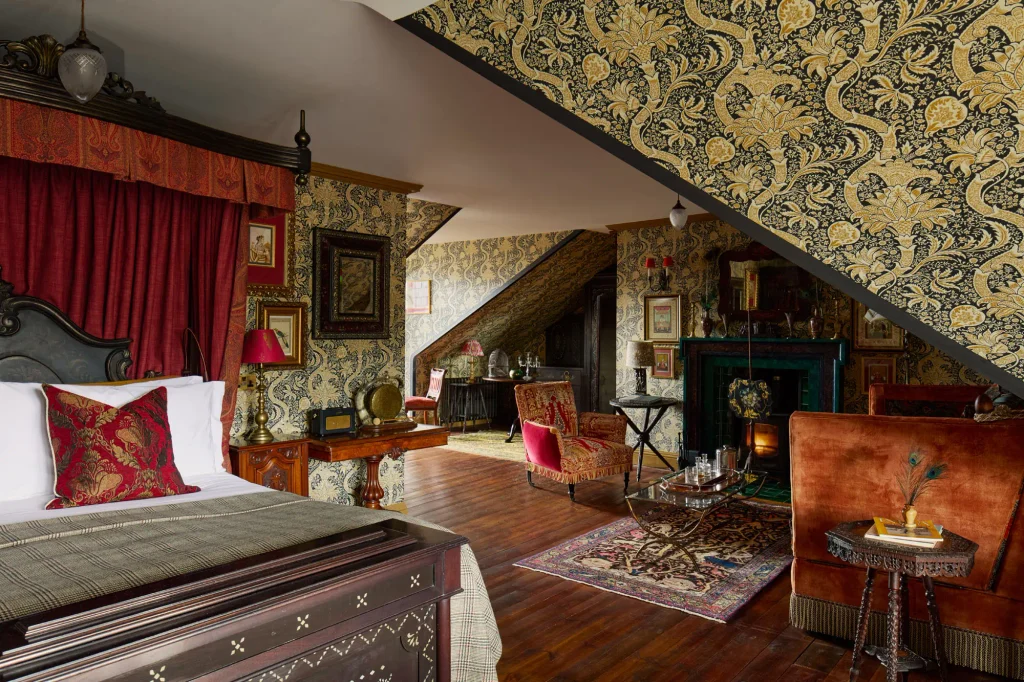
In the Scottish Highlands near Balmoral Castle, Iwan and Manuela Wirth, the couple behind the international gallery Hauser & Wirth, restored and reimagined The Fife Arms. The hotel is filled with a vast collection spanning art, antiques, furniture, archaeology, militaria and other objects, with more than 14,000 pieces incorporated throughout the property. The collection brings together major international artists with Scottish art and objects connected to the history and culture of Braemar and the Highlands.
Among the best-known works is Pablo Picasso’s Tête de Femme, displayed in the lobby, while Lucian Freud’s Child Portrait (Annie) hangs in the hotel’s entrance and lobby area. The collection extends across the rooms and public spaces, where paintings and sculpture sit alongside custom tartans, antiques, historic objects and commissioned interiors.
Guests can take a guided art tour with the hotel’s staff, which adds context to the works they encounter throughout the property. The Fife Arms itself describes the collection as filling the entire hotel, creating an immersive experience rather than a conventional gallery setting.
Benesse House, Naoshima
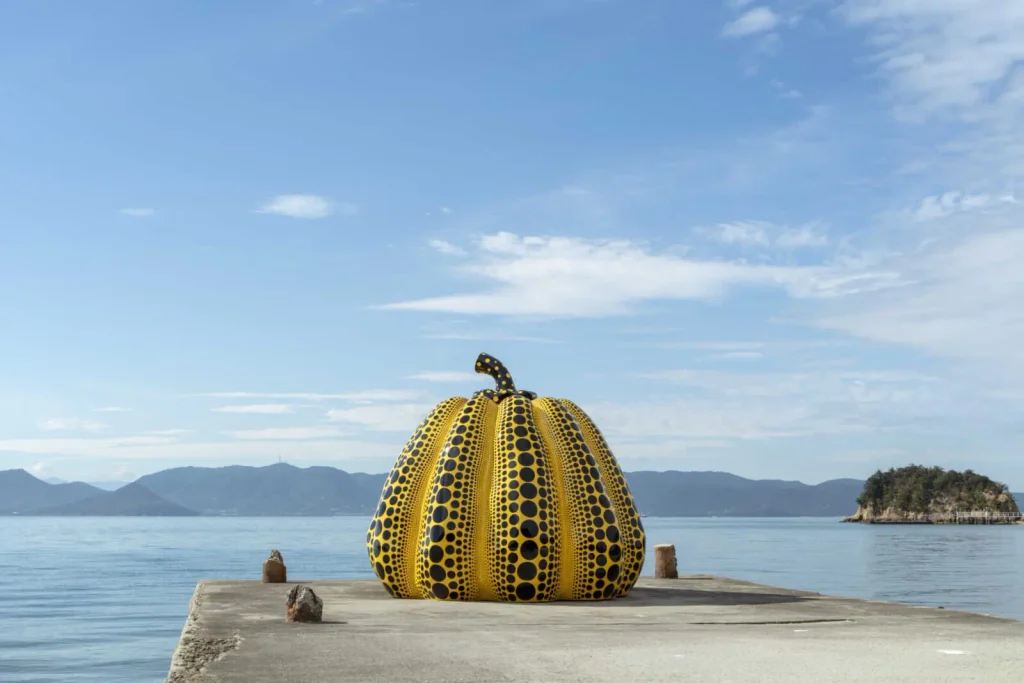
Benesse House is an interesting addition here, as it was conceived as an integrated museum and hotel. Designed by Tadao Ando, Benesse House Museum opened in 1992 around the concept of the coexistence of nature, art and architecture. Set on high ground overlooking the Seto Inland Sea, the museum brings together painting, sculpture, photography and installations from its collection, alongside permanent site-specific works created specifically for the building.
Art extends beyond conventional gallery spaces and into the wider site, with works installed throughout the building, along the seashore, and in the nearby forest. Jean-Michel Basquiat’s Gua-Gua is among the works currently displayed in the museum, and David Hockney’s A Walk Around the Hotel Courtyard Acatlan is also part of the collection. The current displays also include works by artists such as Alberto Giacometti, Cy Twombly, Frank Stella and Bruce Nauman.
The hotel experience is inseparable from the museum itself. Benesse House incorporates guest rooms into the museum building, with artworks by artists represented in the collection displayed inside the rooms. The Museum accommodation currently includes works by artists including Francis Shingo, Sol LeWitt, Thomas Ruff and Jennifer Bartlett, with the specific works varying by room.
Rome Cavalieri, A Waldorf Astoria Hotel
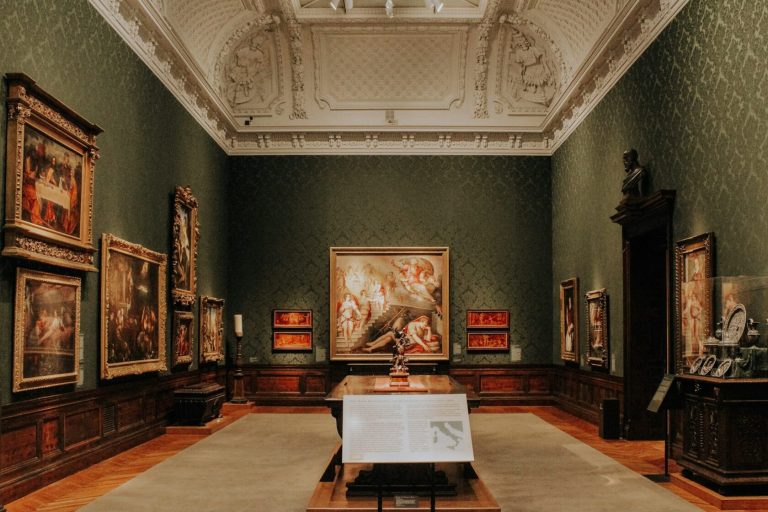
Rome Cavalieri is home to one of the world’s greatest private hotel art collections. With more than a thousand works and objects ranging from Old Masters to contemporary art, alongside furniture, tapestries, costumes and other decorative arts. The collection draws substantially from the holdings of Italian industrialist and collector Angelo Guido Terruzzi, whose wider private collection comprised several thousand paintings, furnishings, tapestries, sculptures and decorative objects. A selection of his holdings became part of the Rome Cavalieri‘s collection and is displayed throughout the hotel’s public spaces and suites.
The centrepiece is the Tiepolo cycle in the main lobby. Three large canvases by Giovanni Battista Tiepolo were created in 1724 – 1725 for Palazzo Sandi in Venice: Odysseus Finds Achilles Among the Daughters of Lycomedes, The Flaying of Marsyas and Hercules and Antaeus. The paintings formed part of the decorative scheme of the Venetian palace and were acquired by Terruzzi at a Sotheby’s auction in 2006, before being permanently displayed in the hotel’s hall.
The central Odysseus Finds Achilles Among the Daughters of Lycomedes is the largest of the three, flanked by the two vertical canvases, and the hotel describes the trio as the three most precious paintings in its collection. The Tiepolo paintings are not confined to a private viewing room, and instead occupy the hotel’s central public spaces, where guests encounter an important group of eighteenth-century Venetian paintings. It is an unusually direct form of access: a major Old Master cycle becomes part of the architecture and atmosphere of a stay rather than something guests need to visit separately.
Faena Hotel, Miami Beach
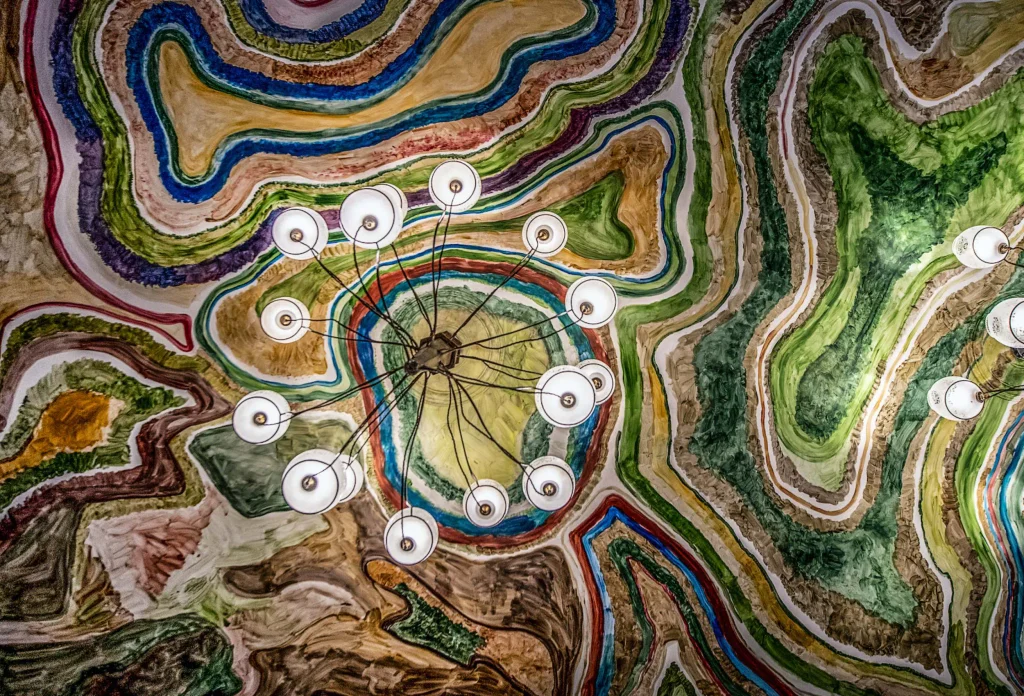
Faena Hotel Miami Beach announces its relationship with art before guests reach the front desk. The entrance, known as The Cathedral, is lined with eight monumental murals by artist Juan Gatti, and these hand-painted works incorporate 23-karat gold leaf and establish the theatrical visual language that continues throughout the property.
Art appears elsewhere across the hotel and wider Faena District, most visibly in Damien Hirst’s Gone But Not Forgotten, the monumental woolly mammoth skeleton gilded in 24-karat gold leaf and enclosed in a glass vitrine beside the Mammoth Garden. The work has become one of the property’s most recognisable visual landmarks.
The hotel was developed by Alan Faena, who brought in Baz Luhrmann and Catherine Martin as creative collaborators on the property’s design. That approach is visible in the way the interiors, art and architecture were conceived together, from the entrance to the commissioned artworks and theatrical public spaces. The property does not feel like a conventional hotel with a few notable works added after the fact, because its visual identity was built around a deliberate relationship between art, design and hospitality, with the creative program extending beyond the hotel into the wider Faena District.
The Last Artistic Note
None of this happens by accident. Each of these hotels treats art as central to the experience rather than incidental, and that choice changes what a stay there can offer. A guest is able to spend time with works beyond the limits of a conventional museum visit, encountering them repeatedly across the course of a stay.
That proximity is worth something, though it is worth being precise about what. A few nights near a Picasso, Basquiat or Tiepolo do not depend on the standing that comes with actually holding one in a private collection, and the two experiences should not be mistaken for each other.
What a stay like this can offer is familiarity: the chance to return to a work, notice details that might be missed during a single viewing and experience art at a slower, more personal pace. For some guests, that will be its own reward. For others, it may sharpen an eye they intend to put to use elsewhere.
Either way, these hotels make a convincing case for art and hospitality occupying the same space without one diminishing the other. The most successful among them understand that a serious collection cannot simply be used as decoration.
It has to remain something worth looking at.
Read later
Share