Memory and Money: Classic Car Collecting Culture in the UAE
 Read later
 Share
Share
In Dubai, a car must be over thirty years old and pass the required technical tests to qualify for classic-vehicle registration. Once it does, the RTA, Dubai’s roads authority, can issue it a special classic plate. The designation has practical implications too. Under Dubai’s registration rules, a right-hand-drive car cannot ordinarily be registered unless it carries a classic plate. Authorities and specialist organisations across Dubai and Sharjah have introduced measures to support the registration, inspection and preservation of classic vehicles. These include a licensing framework and inspection and certification services offered by the Sharjah Old Cars Club.
Getting old cars back on the road
Dubai introduced its classic-car licensing system in June 2012 in cooperation with the Automobile and Touring Club of the UAE, the country’s FIVA representative, the international federation for historic vehicles. Cars had to be at least thirty years old, retain their original parts and pass a technical inspection before being licensed. Eligible cars were divided into six categories according to factors including their age, condition and specifications, with restrictions determining where and when some could be driven. A car with inadequate lighting, for example, could be restricted to daylight use, while one unable to maintain sufficient speed could be kept off the highway.
The introduction of the licensing system provided a formal route for eligible classic cars to be registered for road use, subject to technical inspections and restrictions determined by their classification. This provided a way for eligible cars to return to the road while placing conditions on their use. The rules also addressed modification, with changes expected to preserve the character of the original vehicle. Eight years later, in 2020, the RTA introduced a new classic-vehicle plate, replacing the previous brown design with a predominantly yellow one inspired by Dubai’s licence plates of the 1980s. The qualification remained based on the same central threshold: the vehicle had to be at least thirty years old and meet the required technical standards.
When collecting becomes an investment
Age alone does not determine the value of a classic. Rarity, provenance, condition, originality and demand all influence how collectors assess a car and what they are prepared to pay for it. These questions formed part of the programme at the second Sharjah Classic Cars Festival in February 2025. One discussion examined the relationship between the personal appeal of collecting and its investment potential, including valuation and strategies for building a collection. For collectors, the two considerations can easily overlap. A particular model may appeal because of its engineering, design, history or personal significance. Those same qualities can also shape demand and, in turn, its value on the market. Decisions around restoration, originality and provenance therefore carry financial consequences alongside their importance to preservation.
Memory and paperwork in Sharjah
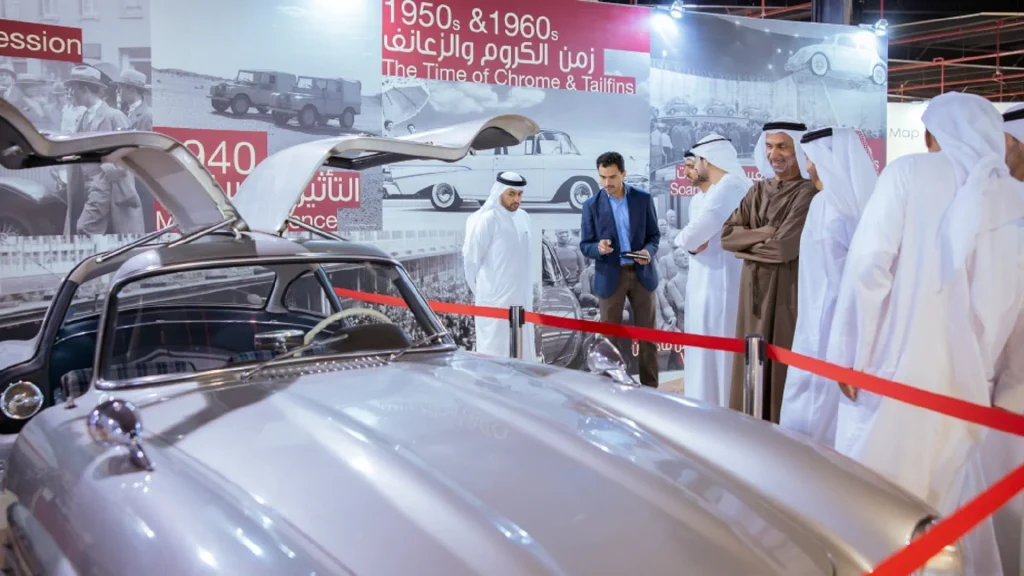
The Sharjah Old Cars Club works to preserve automotive heritage while also handling some of the practical processes that allow classic cars to change hands and remain in circulation. Its services include inspection and certification for ownership transfer, registration and export, along with official verification relating to vehicle records. Its annual festival brings the history behind individual cars into public view. At the second edition in February 2025, exhibits included a 1988 two-door Range Rover Classic associated with the late Sheikh Zayed bin Sultan Al Nahyan and a four-door Range Rover from the same year associated with the late Sheikh Khalifa bin Zayed Al Nahyan. Provenance gives cars such as these another layer of significance. Their histories are connected to figures central to the formation and development of the UAE, giving collectors and visitors a record of who owned and used them alongside the mechanical history of the cars themselves.
When is a changed car still the real car?
Preservation becomes more complicated when an ageing car needs to adapt to modern roads and technologies. The question is how far those changes can go while maintaining the qualities that gave the car its historical and collectable value.
Dubai’s 2012 licensing framework already addressed this issue by expecting modifications to preserve the character of the original vehicle. More than a decade later, electrification has brought another possibility into the conversation, allowing an older car to run with a completely different powertrain.
At the 2025 Sharjah Classic Cars Festival, one discussion considered what electrification could mean for classic vehicles, including its implications for authenticity, market value and their appeal among enthusiasts. At the end of the festival, the Sharjah Old Cars Club announced plans to convert one of its own classic vehicles to electric power while seeking to preserve its original character.
Replacing an engine inevitably raises questions for collectors. The body and interior may remain intact, yet the sound, engineering and driving experience can change considerably once the original powertrain is removed.
FIVA takes a strict approach to the issue. Its definition of a historic vehicle covers one that is at least thirty years old, maintained in historically correct condition, kept outside everyday transport and preserved as part of technical and cultural heritage. Under FIVA’s classification, a classic vehicle converted from its original powertrain to modern electric propulsion would generally no longer qualify as a historic vehicle, unless the modification was carried out during the vehicle’s own period. This position concerns FIVA’s definition of historic authenticity rather than the legal registration requirements of individual countries. Where local law permits a conversion, FIVA recommends making the process reversible. Original components should be identified and stored so that the vehicle can later be returned to its earlier specification.
Where the line sits
Across Dubai and Sharjah, classic cars move between several roles. They are registered vehicles, pieces of automotive heritage, private collectables and, in some cases, investments. Each role places a different value on age, usability, condition and originality.
Those priorities become harder to balance as the cars grow older. Maintaining historical integrity can require preserving components that were designed decades ago, while keeping a vehicle usable may eventually require changes that affect its original specification. Electrification has brought that question into sharper focus.
For collectors, the boundary remains difficult to define. A thirty-year threshold can determine whether a car qualifies for classic registration, while an inspection can establish whether it meets the standards required for the road.
Questions of character, provenance, and originality are harder to measure, especially when the parts that once defined how a car sounded, moved, and felt behind the wheel begin to change.
Read later
Share