What defines diamond quality today, beyond the 4Cs and traditional grading?
 Read later
 Share
Share

How diamonds are currently evaluated
Diamonds are assessed through four familiar metrics — colour, clarity, cut, and carat — established by the Gemological Institute of America. These remain the foundation of grading and the common language across the market.
In practice, evaluation now extends beyond these metrics. It includes how a stone is produced, how it can be traced, and what can be measured alongside its appearance.

A diamond carries both its visual characteristics and the process behind it. In traditional mining, value has been tied to geological origin and extraction, with scarcity determining price. Laboratory-grown stones enter the same framework with matching physical and optical properties, while the production process follows controlled conditions that can be monitored and recorded.
Laboratory-grown diamonds production
Laboratory-grown diamonds match mined stones in composition and optical behaviour. The difference lies in the production process and in the information that accompanies the stone.
Growth conditions can be set in advance, origin can be followed from production through certification, and environmental impact can be measured. These elements now sit alongside grading in how a diamond is assessed.
Who fits in the market?
Within high jewellery, a group of houses works with laboratory-grown diamonds at the highest grading levels. Astrea London operates in this segment, with a focus on high-colour and high-clarity stones produced under controlled conditions.

Founded by Nathalie Morrison, the house selects diamonds in the D–F colour range with high clarity. Certification is provided by the Gemological Institute of America, International Gemological Institute, and Gem Certification & Assurance Lab. Evaluation also includes light performance, symmetry, and optical consistency, which are recorded alongside standard grading data.

Sarah Jessica Parker is the Global Creative Director and shareholder of the house. Her role covers collection development and visual direction. Her experience across fashion, publishing, and design informs how the collections are structured, from proportions to overall presentation. SJP collection is already part of the brand’s current offering.

Astrea Atelier is the house’s bespoke service. The process begins with the client setting the parameters of the stone — cut, colour, and carat. The diamond is then produced according to these specifications. Consultations take place privately, either one-to-one or in small groups. Each piece is delivered with certification and documented characteristics, including light performance and symmetry. The process allows stones to be commissioned to a defined brief, with documentation provided at each stage.
Diamond production standards and supply chain
Production takes place in controlled laboratory conditions. Resource use, energy, and waste are managed within this environment. Compared to traditional mining, the process involves lower emissions and no land extraction. Astrea London presents this difference through a direct comparison of production parameters, including mineral waste, carbon emissions, water usage, long-term environmental impact, traceability, and labour conditions. The data reflect the structure of laboratory production, where resource use, origin, and working conditions are documented at each stage.
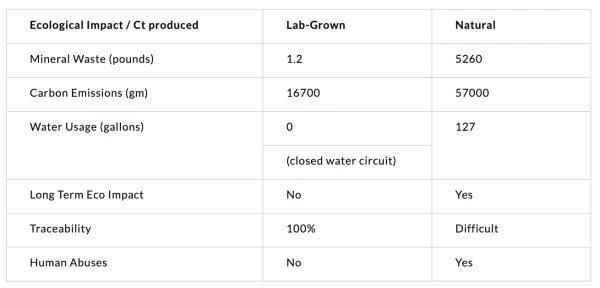
This comparison clarifies how production conditions extend into evaluation. Alongside grading, factors such as traceability and environmental impact become part of how a diamond is considered.
Astrea London works with suppliers under a code of conduct covering labour conditions and traceability. Each stone can be followed from origin through certification.
Philanthropy of Astrea London
Part of the company’s activity focuses on applications of laboratory diamonds outside jewellery, including optics, medical technologies, dental use, and water purification. Philanthropic initiatives focus on education. The house supports programmes in Africa, including work with Sumbandila, providing access to schooling for students from underrepresented backgrounds.

Evaluation of a diamond now combines grading, production parameters, traceability, and documentation. These elements together form the basis for understanding the stone. Within this framework, Astrea London presents a model in which the stone and its production are considered together.
Read later
Share