Mamluk Mastery in the Art of Ornament at Louvre Abu Dhabi
 Read later
 Share
Share
In a city where the future of art converges with the legacies of civilisation, Louvre Abu Dhabi unveils a rare window into a dynasty of enduring influence: Mamluks: Legacy of an Empire, the region’s first major exhibition dedicated to one of the Islamic world’s most sophisticated and artistically prolific dynasties. From 17 September 2025 to 25 January 2026, over 270 works from 34 global institutions coalesce into a sweeping narrative, not only of conquest and culture, but of aesthetic sovereignty.
Curated in partnership with the Musée du Louvre, the exhibition traverses time and empire, from Cairo to Damascus, Mecca to Venice, illuminating the Mamluk Sultanate’s reign between 1250 and 1517. Yet this is no ordinary historical retrospective. It is a masterclass in the power of patronage, the allure of ornament, and the grandeur of style when wielded as diplomacy.
Divided into seven thematic sections, the exhibition draws visitors into a courtly world where beauty was not a luxury, it was strategy. The Mamluks, slave-soldiers turned sultans, commissioned some of the most intricate glasswork, metalware, manuscripts, and textiles in Islamic art history. Their legacy is neither quiet nor peripheral but it is gilded, geometric, and deliberate in its cultural might.
Among the exhibition’s most arresting pieces is the famed Baptistery of Saint Louis (c. 1330–1340), a basin of inlaid metalwork so refined it once served in the coronation rites of French royalty. Displayed now in the Gulf for the first time, its intricate surface of warriors, musicians, and flora transforms utility into sovereignty. Nearby, a helmet bearing the name of Sultan Barsbay (r. 1422–1438) and a key to the Kaaba from Sultan Faraj (r. 1399–1412) offer a tactile bridge between martial and spiritual power that is tangible reminders that beauty was often born from brutality.
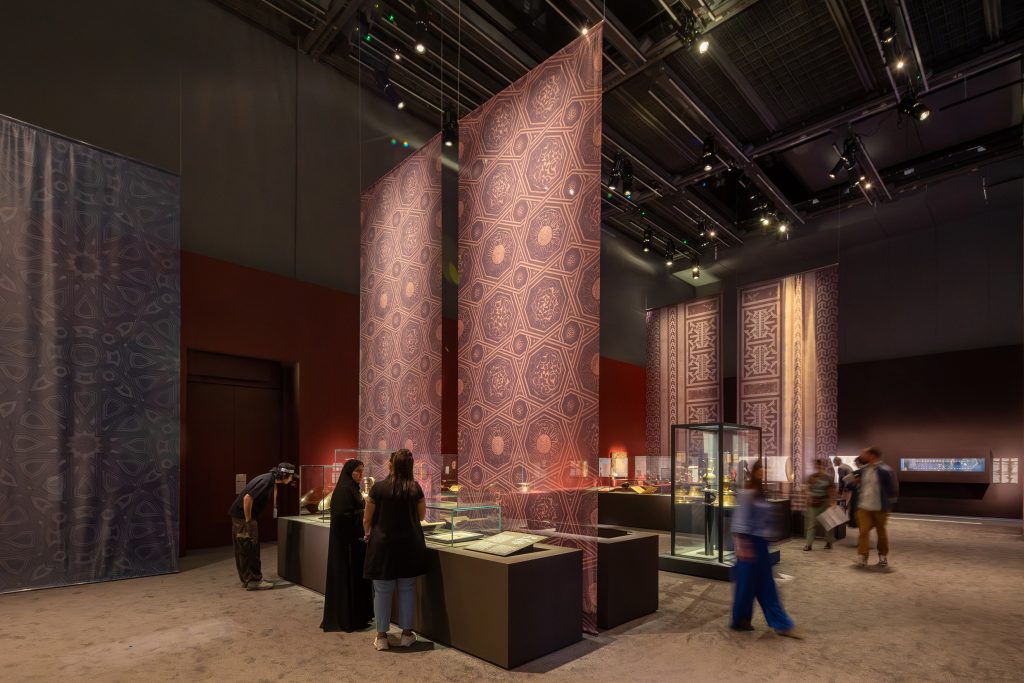
Louvre Abu Dhabi’s own contributions to the display include a rare Egyptian carpet from the 15th century, its medallions as ornate as any court ceiling, and a thirteenth-century Juz’ Amma from the Holy Quran, whose elegant script evokes the sacred geometry at the heart of Mamluk design. One of the most quietly moving pieces is a Certificate of Pilgrimage (Hajj) from 1433 – a parchment not of conquest, but of devotion, inscribed with the name of Maymuna, daughter of Muhammad al-Zardili. In this singular object, womanhood and faith intersect through ink and decree.
What renders Mamluks: Legacy of an Empire exceptional is not merely the scale of its collection, but its ability to reposition the Mamluks not just as rulers, but as tastemakers. Their art is, in many ways, an ancestor to the couture ateliers of today: collaborative, extravagant, richly symbolic. The meticulous detailing in mosque lamps and incense burners echoes in the ornate codes of Cartier or Chopard. Their textiles, elaborate silks, embroidered with medallions, anticipate the visual language of haute couture’s most intricate fabrics.
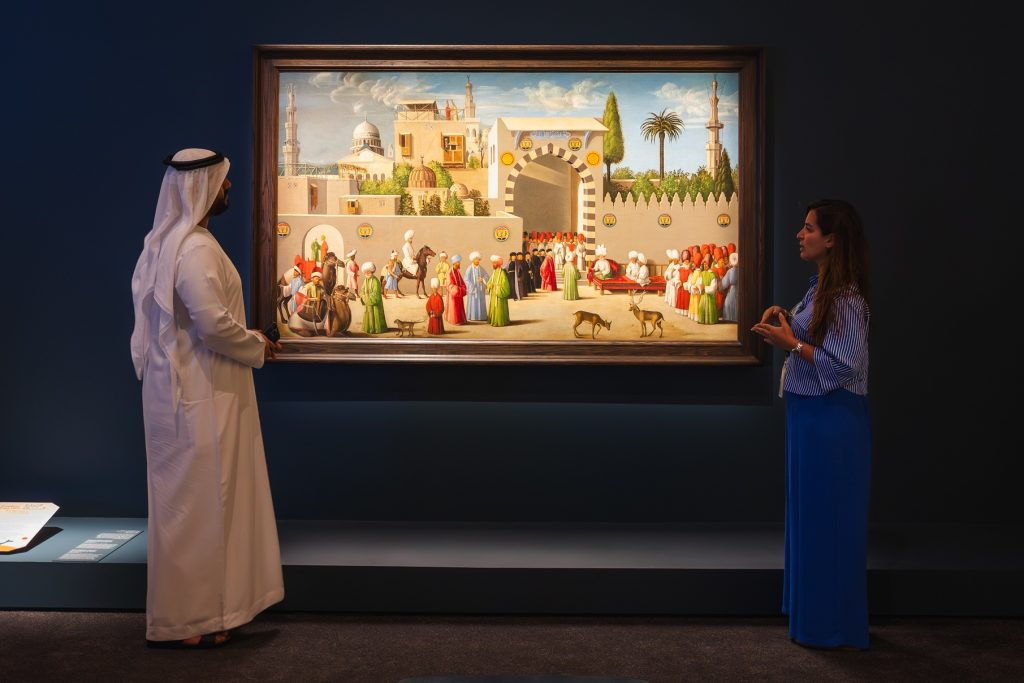
This is an empire that valued cosmopolitanism. In a world long before passports, the Mamluk court operated as a crossroads of diplomacy and commerce. The Venetian School’s Diplomatic Mission Received by the Governor of Damascus (1511) – on display as part of the exhibition – captures the moment where silk, sword, and script met across continents. Today, as Abu Dhabi emerges as a new global nexus, the exhibition reminds us that cultural diplomacy has always been the highest form of currency.
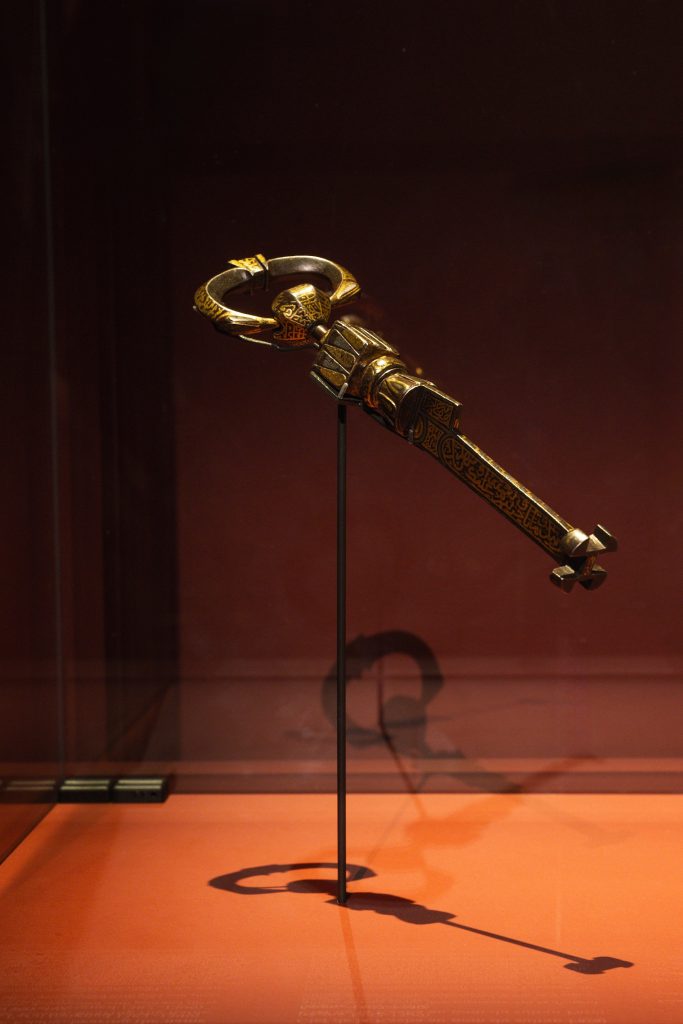
The curatorial brilliance of Dr. Souraya Noujaim and Dr. Carine Juvin lies in how seamlessly they marry scholarship with spectacle. They highlight not only the power structures, but also the underrepresented figures within Mamluk society, women, minorities, intellectuals, whose influence curated the spiritual and material world around them. In this way, the show does not romanticise empire; it investigates its nuance, its contradictions, its beauty and brutality in equal measure.
Technologically, the exhibition is as forward-looking as its subject was in its time. Through digital storytelling, interactive screens, and multimedia immersion, visitors can trace patterns in calligraphy, follow the routes of ancient trade, or listen to audio narratives that transport them to the marble courtyards and candle-lit rooms of the medieval Middle East.
Its elegance is not confined to its walls. A comprehensive cultural programme accompanies the show, from curatorial talks to architectural lectures and even a children’s interactive path, reaffirming the museum’s mission to make culture essential. A podcast allows the exhibition to travel beyond its own borders, and a scholarly catalogue, available in Arabic, English, and French, ensures the research lives on, long after the lights dim.
Louvre Abu Dhabi has often been described as a bridge between East and West, but with Mamluks: Legacy of an Empire, it becomes something more refined: a mirror held up to history, showing how beauty, once wielded wisely, can model empires and endure far beyond them.
Read later
Share