Rabab Tantawy: inspiring lessons in breaking boundaries through art
 Read later
 Share
Share

Rabab’s figures — suspended between memory and myth — have quietly become part of Dubai’s visual language. From seven-storey Mural on Yas Island to intimate canvases in her Al Quoz studio, her work moves between the monumental and the deeply personal. We met Rabab to talk about building an artistic voice, resisting trends, and why public art should belong to everyone.
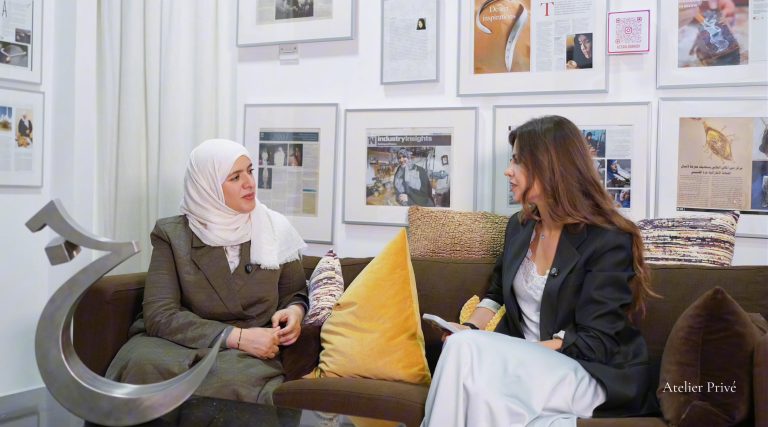
To witness the nuances of this discussion firsthand, we invite you to view the full interview with Rabab Tantawy on our Atelier Privé Experience YouTube channel.
Arina: I’m Arina Ponomareva, founder of Atelier Privé. This is a special project: Why Contemporary Art is a New Code of Luxury. Our guest today is Rabab Tantawy.
Rabab Tantawy: at the intersection of heritage and contemporary art
Rabab, thank you so much for your time today and for speaking with us. We’re excited to explore not just what you create, but also to understand you as an artist — your thoughts and your perspective. Your work sits at the intersection of heritage, contemporary practice, and the personal. My first question is: what are you focusing on right now?
Rabab: Thank you. First of all, it’s an honor and a pleasure to be part of this discussion.
Right now, my work is very studio-focused. I’m developing new ideas and experimenting with materials I haven’t used before. 2025 was a very busy year for me, with many Mural projects and collaborations with brands and companies. This year, I really wanted to focus more on my studio practice and my painting. I’ve started painting sculpture, and I’ve started bringing these figures that I’ve always painted to life in 3D form. I was lucky to be selected for the Tunweer Art Festival, where I created my very first public art sculpture called The Guardians. Since then, I’ve been thinking more in 3D — how I can develop that part of my practice, because I’ve always only painted. So it has always been a sort of 2D view of my work. It’s a completely different way of thinking when you work in 3D and when you think about sculpture or work that can stand on its own. So that’s where my thinking is going right now.
Arina: You’re a great example of someone who started something really big not at a very young age, not from childhood. As far as I know, you started when you were 37. Since then, how do you feel you’ve personally changed?
Rabab: Honestly, the way I started — in a million years I never thought I would even call myself an artist. I wasn’t following a passion, because I didn’t know then that it was a passion. I was almost following a hunch, or a calling to paint, to start painting. It happened after a long career in hotels. I went to hotel school and worked in hotels for 15 years. When I moved here to Dubai in 2003, I worked in the industry for another seven years. So becoming an artist wasn’t something I expected at all. But I followed this calling to express myself in a different way, and this is how it all started. I wasn’t planning anything, and I didn’t even know how to begin or how to do certain things. I think one of the reasons I feel I have a strong foundation is that I taught myself everything. When you’re doing things for the first time — especially here in Dubai, where the art scene wasn’t as developed then — there were barely any resources or support. The difference between then and now is huge. Seeing the art scene and the creative community grow this much is a really proud moment for me, because I’ve been part of it from the beginning. Going back to your question, since I was teaching myself everything, there was a lot of failure before things started working. Even with the basics. I also had mentors along the way, and what helped me is that I never shied away from asking. If I admired an artist, I would reach out. I once messaged an artist in the US and simply asked, “Would you like to be my mentor?” because I loved his work and wanted to learn from him. It’s very important to find mentors and people who can help you grow and guide you in your career.
Arina: For many people, it’s actually not easy to approach others and ask for help or advice. Everyone is kind of afraid of rejection.
Rabab: I always say, what’s the worst that could happen? They say no — and that’s okay. Rejection affects everyone. Anyone who says it doesn’t is lying. It hurts, no matter how experienced you are or how confident you feel. But you have to move past it and go to the next thing. If one door doesn’t open, there’s usually a reason. Maybe it wasn’t your time yet, or maybe it wasn’t right for you. I strongly believe that things work themselves out for your benefit. Looking back now, there were things I really wanted and didn’t get — and I’m actually glad I didn’t.Asking for help is one of the best things you can do in any career and in life. If it doesn’t work out, it’s fine. You just train yourself to overcome that feeling and move on. Something better will come.
Studio 13: a space without barriers for emerging artists
Arina: What you said is really useful for many people today.
Rabab: Especially new artists. And I’m going to jump ahead and talk about Studio 13. One of the things we wanted to cultivate here is a space where artists don’t need to apply, fill out forms, or tell us their life story so we can decide whether they deserve to be here. For years, I personally struggled with feeling that I had to prove myself, write big words, or describe my work in a very intellectual way — sometimes not even in a way that felt true — just to fit into the art world. Unfortunately, there are still barriers. Not everywhere — many institutions and galleries are very supportive — but often artists feel they have to write their bio or talk about their work in a very specific way. And not everyone knows how to write about their art. You can be amazing at painting or sculpture and still not be good at explaining it in words — and that’s completely fine. There are many famous artists who don’t explain their work at all, and that’s perfectly okay.
Arina: Do you think this is actually one of the strengths of contemporary art — that you don’t necessarily have to explain everything? You’re expressing emotions or thoughts, and each person can interpret them in their own way.
Rabab: Yeah. I mean, that’s part of the beauty of it, I guess. That’s why it’s open to all interpretations. One of the things that I love is when someone looks at a painting of mine, and I always ask them, “So, what do you think? How do you feel?” Especially because I do a lot of figurative work — it’s about people, it’s about connections. Whenever someone tells me how they feel looking at one of my paintings, they usually say, “This reminds me of me and my brothers,” or “This reminds me of my best friend,” or “This is me and my mom.” That part also informs the artist, because you understand how people feel when they see your work. Not necessarily to change it, but it validates what you’re doing. I think the best validation is when someone sees your art and feels something — whatever that feeling is. It evokes an emotion, maybe a memory. Sometimes a color reminds them of their childhood or something personal. There are so many things an artwork can do to you just by looking at it. And sometimes it’s not even a pleasant feeling — but it’s still a feeling, right? There’s still an emotion. And for me, that’s a very successful thing.
Arina: Art doesn’t really have a practical purpose or use. You can say, “I like art” or “I don’t like art,” but it’s not something you absolutely need to have at home. It’s not necessary, right?
Rabab: Right.
How UAE evolved: from limited opportunities to a thriving art scene
Arina: You mentioned that back then, here in Dubai, there were fewer opportunities for artists. I’ve also spoken to other artists who said the same — some of them started in the 1980s or even before 2000. What do you think actually shifted in the UAE, especially in Dubai, that created so many opportunities today?
Rabab: I think it’s something very unique to Dubai, or the UAE in general. It’s a very young country, but it has developed so much in the past 30–40 years. Automatically, everything else develops with it. It’s not only the creative scene — it’s every field: construction, development, everything. The whole city, the whole country has grown so fast. To see the Guggenheim about to open, to see the Louvre — this belongs to a very clear vision. There’s definitely an open and progressive vision here. Right now, everybody wants to come to Dubai. I always say it’s the land of opportunity. Whether you’re an artist or anyone else, people come here looking for a better life, for safety, for growth. All of these things came together, and that’s why the creative scene developed too. I remember very vividly there were only two places where you could buy canvas or art materials. There was no Amazon, you couldn’t order anything online. Even small things were obstacles. Now everything is available. You can find any material you want. I used to travel and bring back a full suitcase of supplies. Now sometimes I travel and can’t even find what I easily find here. So many elements came together to make the art scene flourish. And because there’s so much happening here, the attention is naturally on the art scene. As a studio, we get weekly emails from artists asking about residencies or exhibitions — from the US, from Europe, from places we used to think we had to go to. Now people want to come here.
Arina: So many galleries are moving to the Middle East now — Opera Gallery, Leila Heller Gallery — places where artists can be represented. Where people can discover your work?
Rabab: So, my work isn’t gallery-represented. I’ve created my own ecosystem with Studio 13. I also started doing Murals later in life. I think I was 43 or 45 when I first used spray cans and painted on walls. It was such a freeing experience. At first, I just watched my friends who were street artists and I was in awe. Then I tried it myself, and it became addictive. It gives you a real sense of freedom, and there are no limits to what you can do. My very first commissioned Mural was in Al Seef. It was meant to stay for only a month or two during the shopping festival, but I painted it in 2020 right before COVID, and it’s still there. People still take photos of it. Those were my first public Murals. After that, I did several collaborations. I worked with Aldar Properties on Yas Island — two seven-story buildings that I painted myself, even though I’m afraid of heights. I had to overcome that and paint from scaffolding. My most recent Mural, which I’m very proud of, was commissioned by Dubai Culture here in Al Quoz as part of the Creative Zone initiative. It’s almost a 500-square-meter wall, which was very challenging.
Arina: How long did it take you?
Rabab: A little less than a month. But it was June and July, so the temperature and humidity were insane. We had to work at night. Working at night is really hard. The light is never the same as daylight, no matter how much you add. We worked every night from eight in the evening until four or five in the morning. It was one of the most challenging things I’ve ever done. But the public art aspect is very rewarding, because you don’t dictate who sees it. It’s for everyone. And the reactions you get — messages from people saying they saw it, that it transformed the space — that’s very special. Most of my work now lives outside. Or you can come to the studio.

Rabab Tantawy and public art: creating for everyone
Arina: A big part of your practice exists outside traditional gallery walls, within the city itself. Do you feel any responsibility, since your work can be seen not only by collectors or art enthusiasts, but also by people who aren’t really into art?
Rabab: I think that’s the beauty of public art. That’s exactly why I love it so much — it’s for everyone. And art should be for everyone. It belongs to everyone, because we’re all innately creative. We’re born creative. The art world sometimes puts restrictions on who art is for, but it shouldn’t be like that. It should simply evoke an emotion — make someone feel something, or even feel calm or at ease. Having art in the street, art that belongs to people, feels like the highest form of sharing. You don’t control who sees it or who likes it. It’s for the public. It changes how a place feels. If we talk about Al Quoz, for example, it’s very industrial and gray. That affects you. We already know how art can influence healing — that’s why hospitals have art now. It’s the same idea. You transform a street, and suddenly it doesn’t feel the same anymore. Seeing that before-and-after transformation is one of my favorite things. I remember the security guard of the building we were painting told me that he started getting off the bus one stop earlier just so he could walk along the wall. Even in the middle of summer heat.For me, that was the best compliment ever.
Arina: Wow. That’s a beautiful story.
Rabab: We had bus drivers — there’s a bus station right next to the wall. The drivers would stop, give us a thumbs-up, say “This is great,” or ask questions like, “What are you doing?” It’s still not very familiar, especially in Al Quoz. You expect to see art in a restaurant or in a public place where art kind of belongs. But in the street, in that specific area, people were confused. They were wondering if we were even supposed to be there. And then we had people honking their horns, cheering. It was just the best feeling ever.
Arina: You said that Al Quoz is a very industrial area, and that’s true. But at the same time, it’s also one of the most creative areas, because there are a lot of galleries and studios. It really feels like a creative place.
Rabab: It’s definitely a creative hub. We started Studio 13 in 2021. Alserkal has always been there — it’s really the anchor that brought all the galleries in. It’s one of the cornerstones of the art scene in the UAE. Then you feel one space opening, then another next to it, and another one. Now you have Al Khayat Avenue and many more art-focused places around the area. That helps us too. It’s much easier to invite someone to visit the studio when you can say, “We’re right on the same street as Alserkal.” Being in the middle of the art hub makes a big difference.
Why luxury brands like work with artists
Arina: A lot of luxury brands try to collaborate with contemporary artists or involve them in different kinds of projects. Why do they do this? How does it help them strengthen their brand or status?
Rabab: First of all, I feel art should be part of everything. Even creating a logo or a campaign involves creativity. Some people don’t consider that art, but I personally see it as a form of creation. In the past ten years, there’s been a huge focus on originality and new ideas. Consumers’ attention has become very hard to capture with all the social media and constant exposure. Collaborating with artists brings a level of authenticity that regular campaigns or graphic design sometimes can’t. It becomes more personal. When you collaborate with an artist, you’re collaborating with their thoughts, their experiences, their personality. That adds something unique to the product — something you can’t replicate. It’s not just marketing numbers. It feels human. And artists can elevate a product or show a side of it that people wouldn’t normally see.
Arina: Are there any brands you’d love to collaborate with in the future?
Rabab: Honestly, I was ready to retire after McLaren. (laughs) I’m a huge Formula 1 fan, so when I got the call asking if I wanted to collaborate, of course I said yes. It was completely unexpected, and very secretive at the beginning — lots of NDAs. But that collaboration gave me something a brand can give an artist that you could never achieve alone: reach. Being the first artist to ever put art on a Formula 1 car in 2021, during one of the most watched seasons, meant millions of people saw my work. A gallery can’t give you that kind of exposure. A brand like McLaren, or Bvlgari, or Hermès — they bring their entire audience with them. That reach is incredible.
Arina: You mentioned your collaboration with McLaren. I think for any artist that would be such an honor.
Rabab: It’s a dream. Almost a dream I didn’t even know I had. Because it wasn’t something that had been done before, so you don’t even think it’s possible.
Arina: After working with such a big brand, did you notice any personal changes in yourself — not career-wise, but internally?
Rabab: During the project, I barely slept. It was extremely nerve-wracking. The stakes felt very high. They gave me complete freedom, which is every artist’s dream — but it’s also a lot of pressure. You keep thinking about the audience the brand brings. With McLaren, it’s Formula 1 fans. They’re very attached to their cars. I kept wondering, “What if they think I ruined it?” It’s almost sacred to them. So there’s a lot of self-doubt. I think most artists have imposter syndrome to some extent. But I also feel doubt is necessary. It makes you question whether you’re being true to yourself or just trying to please people. The best collaborations happen when brands give artists freedom while still having a clear brief. They hire you for your voice, so you have to stay true to it. If it doesn’t work out, then it simply wasn’t meant to be.

Arina: From your experience, if a young artist wants to collaborate with brands, what steps should they take? Just sending emails usually doesn’t work.
Rabab: Yeah, we all know that doesn’t work. What I constantly tell everyone who asks me things like, “How can I get into this gallery?”, “How can I paint this Mural?”, “How do I attract a certain brand or get noticed?” — I always go back to the same advice. It might sound cliché, but stay true to your art. When you do that, you naturally develop a style. You develop a voice. And that doesn’t happen overnight. A lot of people today think they can start now and in six months have hundreds of thousands of followers, go viral, or suddenly “make it.” But things take time. And not just time for the sake of waiting — time to actually understand yourself. To figure out your voice. To really dig in and see who you are as an artist.
For me, it took years. Five or six years of trying different things. I even started with portraits, believe it or not. I experimented with so many styles. I liked something about each of them, but none of them fully felt like me. It wasn’t until I kept doing the work over and over that something finally clicked — like, this is it. This is my voice. This is my way. And developing your way is so important before you start reaching out to people. Because imagine trying to convince someone to hire you when you don’t even know who you are or what you stand for. It’s almost impossible.Of course, you also have to put yourself out there. Right now we have social media, and it’s this huge public space where anyone can see you. You don’t really control it — you just show up and exist there.
So share your work, even if you’re not 100% confident in it. Sometimes I look back at things I posted years ago and, as my kids would say, I cringe. But those moments were part of my journey. There were a lot of cringe moments before the good ones. Then more cringe moments. Then growth again. You only really see that when you look back. So don’t be afraid to share your process, even if the work isn’t perfect. It’s like inviting someone into your studio — they see pieces at different stages, unfinished experiments, works in progress. You’re letting them into your world. And if it’s authentic, people respond to that.
What doesn’t work is copying. A copy of a copy of a copy — chasing whatever just went viral. That’s why so many people feel lost or distracted online. They see something get views and think, “I’ll just do that.” And when it doesn’t work, they quit. We’ve all seen people give up because they were doing it for the wrong reasons — waiting for external validation from Instagram or social media instead of doing the work because they genuinely love it. And on a practical level, build a strong portfolio. Work on your bio. Work on how you present yourself and talk about your work. I’ve probably created countless portfolios over the years, and they keep changing — and that’s completely normal. Your portfolio should evolve as you evolve. As your work grows, the way you present it should grow too.
Arina: It’s especially useful for young artists, because there isn’t really a clear “marketing path” for them. It’s not like athletes who easily get sponsors. For artists, it feels much harder.
Rabab: And there is no one way or another. Some people really find their way in ways they didn’t even expect. A lot of people find their way through social media, other people through galleries, and some people just create something, give it to someone, and then someone else sees it. There are just so many paths. I think the basis is to create what you want to create, not what you think is hot or trending at the moment.
Getting started in art: a guide for beginners by Rabab Tantawy
Arina: We talk a lot with you about young artists, but if we look at it from the other side — the people who actually look at art and follow art practices — how do you think they should start getting into this field? Because I’ve noticed that people often become interested in art later in life, not necessarily from childhood. At some point they just feel like, okay, this is something that really interests me. So if someone is just starting and wants to understand art better, what would you recommend? Going to galleries, reading books, watching videos — what should they actually do?
Rabab: For people who are interested in art in general, I would say — this is actually how I personally got into art — there was this one artist whose work I loved so much. And I just started following everything about her. Where her work was shown, her story, how she started, what she meant by what she was doing. So I think it always starts with a simple interest. Maybe you’re drawn to ceramics, or pottery, or sculpture, or painting — whatever it is. And now the whole world is basically in our pocket, on our phone. You can even take a photo of a painting you like — even if you don’t know who the artist is — and just Google search it and learn more. I do that all the time. I take photos, look things up, read about the artists, see how their journey unfolded.
And I also always invite people to actually try making something themselves. Do some creative work. We get so restricted by ideas of what art should or shouldn’t be, what is good or not good. And artists hear this all the time — “Oh my God, you’re so talented, I wish I had your talent.” As if talent is something you’re just born with and that’s it.
But I really believe you can do anything you want. Especially in art. I mean, you can’t build a computer if you don’t know how to build one. But you can create a piece of art that expresses how you feel. Nobody can really tell you if that’s good or bad. It serves a purpose for you. It’s your expression — on paper, on canvas, with paint, or even just with a pencil. And I think when people try it themselves, they also start to understand how hard it actually is. Because we all know those comments like, “Oh, my five-year-old could do that.” But once you start creating, you realize how much goes into it — how much learning, how many mistakes, how much repetition. You really start to respect the work more.
Arina: It’s not easy, you know, to start — wherever you start. You really need to keep practicing. And I also think that for artists, when they begin, they usually start with the basics. Maybe they draw nature, or try to paint realistic objects and scenes. But I feel like one of the most difficult things is actually finding your own style. You have the foundation, you have the experience, but the most interesting — and at the same time the hardest — part is discovering what’s really yours. Was there a specific day, or maybe a period in your life, when you realized, “Okay, this is my way, this is how I want to paint”?
Rabab: I think it’s — first of all, yeah, it is difficult, but it’s also not that difficult at the same time. For me, the change happened more gradually, over time. When I started, I was painting portraits, and I was doing very detailed work. That actually taught me a lot about how to paint. And in the beginning, I only worked with oils — that’s how I learned. And bit by bit, I started realizing what I didn’t want to do. Little by little, I understood that all those details were very frustrating to me. Not just frustrating — I simply wasn’t enjoying them.
And the only reason I started painting in the first place was because of that feeling I get when I paint. That was the real drive for me. It was more about the feeling — feeling calm, at ease. Almost meditative. Like being in that flow state where your mind just goes quiet and all the noise stops. So I think what really happened is that I figured out what I didn’t want anymore. And then I found myself painting these figures with white robes and turbans, and I was really enjoying it. Every time they looked different, and that excited me.In the beginning, when I decided this is what I wanted to focus on, it was really about checking in with myself — how do I feel when I do this? Does this actually bring me joy or not? (laughs)
And again, it goes back to knowing who you are and what your voice is — getting in touch with how you feel while you’re creating. Of course, there’s always a bit of frustration too. Because sometimes you start a painting and it’s not going the way you imagined. You look at it and think, “Oh my God, this is terrible.” But that’s just part of the process. You keep working, you push through, and suddenly it becomes better, and then you’re happy with it.
It’s kind of the same with everything. You have to give yourself time to go through that process — making something, enjoying it, feeling connected to it, thinking, “Okay, maybe I can do better next time, but this is what I want to do.” For me, I was just enjoying it so much. I kept thinking of new ways to paint these figures, what they meant, where they came from, how they’re connected to each other, why I’m even painting them. Because sometimes you don’t really know why you’re doing what you’re doing — especially if you’re creating for expression, not for some specific end result.
Arina: Thank you so much for sharing your story. And thank you for this conversation. For me, whenever I read about your work or see interviews with you, it’s really inspiring — not only your achievements as an artist, but your whole journey. I think it’s a great example for many people, whether they’re artists or just someone who has something inside and wants to start, even if it’s not from childhood. And what I really notice in every interview with you is this idea of being consistent and not giving up, even if someone doesn’t like your work or if it’s not trendy at the moment. So thank you so much for the inspiration, and thank you for all the advice you shared with artists and with people who are simply interested in art.
Rabab: Thank you so much. It was a real pleasure. I really loved our conversation. We could have talked even longer, but it was very nice. Thank you so much for having me.
Rabab’s journey reminds us that art is as much about persistence and self-discovery as it is about talent. Her advice to young artists — to stay true to their voice, embrace the process, and put themselves out there — goes far beyond the canvas. In a city growing into a hub for creativity, Rabab Tantawy continues to transform public spaces and personal stories, inviting everyone to experience art as a shared, living presence.
Read later
Share