The Life and Work of the Emirati Artist Azza Al Qubaisi
 Read later
 Share
Share
Chapter One of the Atelier Privé special project “Why Contemporary Art Is the New Code of Luxury,” a curated series that brings together the voices, visions, and personal narratives of artists from across the Middle East. Through in-depth conversations and studio encounters, the project explores how contemporary expression, heritage, and individual perspective converge to shape a new language of luxury in our time.

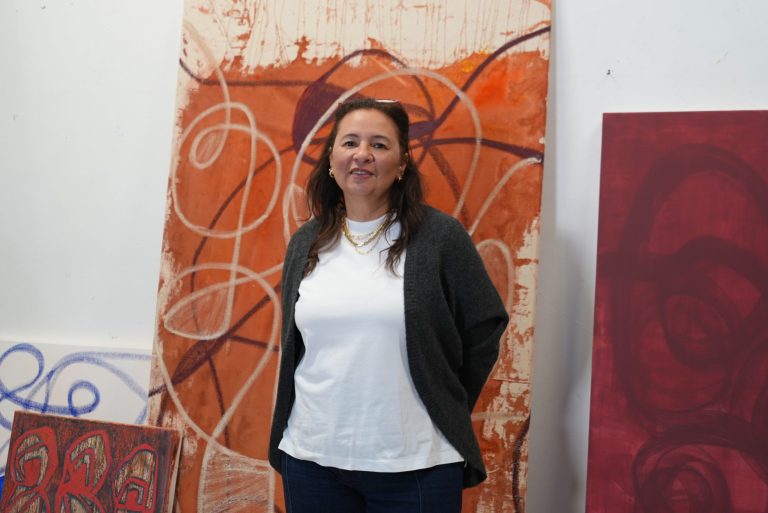
Today, we are honored to step inside the studio of Azza Al Qubaisi — a multidisciplinary artist, designer, and one of the defining creative voices of the Emirates. Surrounded by metals, palm fronds, sculptural fragments, and sketches, we begin our conversation about identity, nature, heritage, and the quiet force that shapes her artistic path.
The Beginning: A Moment of Clarity
Atelier Privé: You studied in London, and you have spoken before about the importance of that formative period. I’m curious — when did you first realize that creativity was not just a hobby, but your life’s path? When did everything begin?
Azza: For me, it was definitely when I was in Oxford. I was doing my A levels to get into Chelsea College of Art and Design for my foundation year, and it just hit me that all I wanted was to do more creative work rather than academic work. That was when I called my father and told him I was changing my major and applying to Chelsea. The journey began there.
As much as it was a new path, it made me happy and confident. I had zero doubt. I always describe it as visualizing a golden door opening for me, held open by my father. He told me, “If you succeed, it is your success. If you fail, it is also your failure.” That responsibility at eighteen was the best thing I ever did for myself.
Family Support and Freedom
Atelier Privé: How did you feel when you realized your family supported you fully?
Azza: It’s a privilege — not everybody gets that. My father was very educated and very supportive. I didn’t want to let go of that opportunity. I used my time wisely to learn as much as I could for my career and my life.
Heritage, Nature, and Identity
Atelier Privé: Most of your work is connected to heritage, your nation, your community. Has it always been this way?
Azza: My work reflects my culture and identity — my search for understanding myself. Nature has been vital: the desert, the sea, the mountains, the palm tree. These elements are part of who I am. The more I understand myself, the more people see themselves reflected in my work because many Emiratis connect with these same elements.
To me, uniqueness is appreciated when it is honest.
What Art Reveals About the Artist
Atelier Privé: Many artists say that their work teaches them something new about themselves. What has your art taught you?
Azza: It taught me patience — a skill I didn’t have. It taught me that I deeply enjoy connecting to nature. I didn’t know that until I lived in London. I didn’t know I loved my desert. After coming back, it became very clear. I even make it a tradition to spend every New Year camping in the desert with my family. Nature grounds me.
Connection Through Art
Atelier Privé: We spoke about what you discovered through your art. What do you hope others discover when they encounter your work?
Azza: The more honest I am, the more people connect in their own ways. I used to enjoy walking around exhibitions and listening quietly to how people interpreted my work when they didn’t know I was the artist.
One of the most touching moments was meeting an Iraqi man who saw my pieces made from palm. His eyes filled with tears. It reminded him of his childhood and the farms that were burned. That human connection through nature is vital. If my work brings memories — real or imagined — it connects us to our humanity.
Middle Eastern Art on the Global Scene
Atelier Privé: I see more and more Middle Eastern artists in galleries across New York, London, Paris. Do you think the art of the region is more about collective memory or self-expression?
Azza: It depends on perspective and curation. An artist’s work is always personal, but a collective memory is formed when works are exhibited together. You see shared elements: palm trees in paintings and sculptures, familiar landscapes, cultural motifs. When the work enters a new space, it gains a new layer — a memory of the moment and person behind it.
Collectors, Legacy, and First-Generation Artists
Before we began recording, Azza mentioned that she has always invested in art, especially Middle Eastern art.
Atelier Privé: Could you name some of your favorite Emirati artists?
Azza: Oh, that’s difficult, because I love them all. It has been almost a mission impossible to focus only on first-generation Emirati artists — but their work is vital to all of us. I love them all: Dr. Najat, Muna Al Khaja as a female artist, Dr. Muhammad Youssef, Abdulrahim Salem, Muhammad Ibrahim.
Do I dream of having all of them? Yes, for sure. Do I have some of them? Yes, alhamdulillah. Their work inspires me. If they made it, then I can push and make it too.
Why Brands Collaborate With Artists
Atelier Privé: Today, brands collaborate with artists more than ever. Why now?
Azza: It’s interesting to see big commercial brands funding the creation of artworks. When I was commissioned years ago, I loved it — it brings our art to different audiences and connects us to networks we otherwise wouldn’t reach.
It’s a win-win collaboration.
Wearable Art and the Question of Local vs. Global
Atelier Privé: Your collection includes jewelry — beautiful pieces. Why do people still often choose famous brands instead of exploring local ones?
Azza: Because wearable art and commercial brands are two different worlds. Buying local is something modern — we hear it more in the past five years. People now appreciate local production for environmental and sustainability reasons.
Wearable art is a very new sector. Although I have existed in this field for twenty years, the sector needs more artists. Commercial jewelry and wearable art are completely different. Your investment depends on what you seek: something pretty to wear or something meaningful that connects you to the artist.
As for placing my wearable art in very commercial environments like malls — I prefer to keep it exclusive, for those who seek it intentionally.
I’m very happy that I have started producing larger public art pieces. Instead of one person owning a ring, now many people can enjoy a piece of mine in a public space. That means a lot to me.
Raising the Next Generation
Atelier Privé: You have a powerful presence as a woman — free, strong, expressive. How do you raise your children? Do you give them the same freedom?
Azza: For sure. A lot of people say, “Your kids are artists,” but I don’t know if they want to be. Giving them the choice is important. I was given that choice, and I want to give it forward.
Their world is more digital than physical, so I try to encourage them to experience the real world: working with their hands, touching materials, painting.
One of my daughters loves working with her hands; the other enjoys drawing characters. Opportunities today are endless — let’s see where their paths lead.
AI and the Future of Art
Atelier Privé: We spoke briefly about AI before recording. Do you think art created today with AI will have the same timelessness as traditional art?
Azza: I’m not sure about timelessness, but I enjoy the tool. I was afraid at first, but I always push myself to understand new things. I took courses and workshops — it gave me access to a new way of creating.
AI will only give you what you put into it. It’s useful for generating initial ideas that used to cost me a lot of time or money. But it can be misused — especially when people take other artists’ works and merge them.
Like any technology, it depends on intention. For me, understanding it was important. I find it very helpful.
Advice for Those Entering the Art World
Atelier Privé: Could you recommend where people should begin when they are just starting to explore the art world?
Azza: Studio visits. It has never been easier to access artists. Visit galleries that represent them, see the work in person — especially if you’re investing. I meet people visiting Abu Dhabi or Dubai who come to see my work, and I think that transparency is important. It helps people understand why they want to connect with an artist.
Atelier Privé: Thank you so much for sharing your voice and your vision with us. It was wonderful to get to know you better — not only through your art, but also through your personality.
Azza: Thank you very much for coming. You made my day.
As we left her studio, the atmosphere lingered — the quiet weight of heritage, the sincerity of her craft, and the unmistakable clarity with which she moves through the world. Azza Al Qubaisi’s voice stands at the intersection of memory and modernity, shaping a language of contemporary art that is deeply rooted yet open to the future. Her story becomes the first chapter of our special project, marking a thoughtful beginning to the conversations that will follow.
The full video interview is available on our YouTube channel, Atelier Privé Experiences.
Read later
Share