Art Basel Qatar 2026 Debuts in Doha with Monumental Holzer Commission
 Read later
 Share
Share

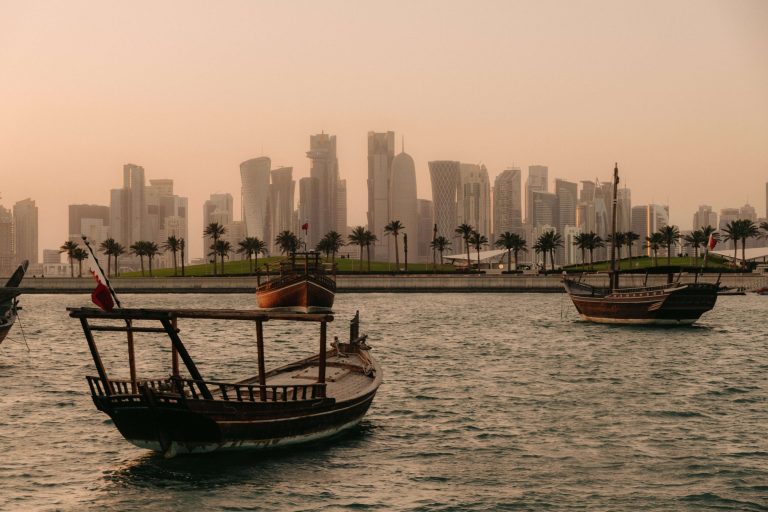
Art Basel has opened its first edition in the MENASA region, inaugurating a new chapter for the global fair. The event runs across Msheireb Downtown Doha from 5 to 7 February, with VIP Preview Days on 3 and 4 February, bringing together 87 international galleries and the work of 84 artists, over half of whom come from the Middle East, North Africa, and South Asia.
The fair unfolds across M7, the Doha Design District, and public spaces in Msheireb, favouring solo artist presentations over traditional booth displays. This arrangement allows visitors to engage more deeply with individual practices and encourages dialogue across regional and global art scenes.

Artistic leadership is provided by Wael Shawky, Artistic Director, and Vincenzo de Bellis, Art Basel’s Chief Artistic Officer and Global Director of Fairs. Their curatorial framework, Becoming, establishes a conceptual throughline for the fair, highlighting transformation in material, social, and historical terms.

A Night for Public Art
On the eve of the first Preview Day, Art Basel Qatar and Visit Qatar unveiled SONG, a new work by Jenny Holzer, at the Museum of Islamic Art. This site-responsive installation is the tenth Special Project in the fair’s program and the first major public commission of the edition.
The work activated the museum through dual projections on its main façade and inner courtyard, accompanied by a choreographed drone performance of over 700 units. Holzer’s projections feature texts by Mahmoud Darwish and Nujoom Alghanem, weaving Arabic and English into a public display of rhythm, illumination, and interruption. SONG remains on view nightly during the fair, anchoring Art Basel Qatar in Doha’s civic and cultural landscape.


The Regional and Global Dimension
Art Basel Qatar represents a defining moment in the fair’s 55-year history. It builds on Qatar’s long-term investment in cultural infrastructure and positions the MENASA region firmly within the international art market. The fair’s format connects local practices with global galleries and collectors, supporting sustained artistic and institutional growth.
Leading voices in Qatar’s cultural and sports sectors have framed the fair as a platform for exchange and dialogue. Her Excellency Sheikha Al Mayassa bint Hamad bin Khalifa Al Thani, Chairperson of Qatar Museums, highlighted the fair’s role in curating a space that uplifts creativity across the region. Nasser Al-Khelaïfi, Chairman of Qatar Sports Investments, and Saad Al-Kharji, Chair of Visit Qatar, emphasized the fair’s importance in placing Doha on the global cultural map.
From the Art Basel perspective, the edition reflects a long-term, locally embedded vision, connecting MENASA artists, galleries, and audiences with the wider Art Basel network. It signals a model of growth that is both entrepreneurial and culturally rooted.


Looking Ahead
As the fair continues through 7 February, the program highlights both galleries and Special Projects, with additional conversations, installations, and performances across Msheireb Downtown Doha.
By situating exhibitions and public commissions throughout the city, Art Basel Qatar allows visitors to experience contemporary art not as a market event alone, but as a cultural ecosystem in which urban context, civic space, and artistic practice intersect.
Read later
Share